EpioxaCareConnect™ is the one place for all the support you need

EpioxaCareConnect is a free program that supports you
Connect with our Dedicated Patient Support Team who can:
- Help you understand Epioxa treatment and how it works, the potential benefits and risks, what the procedure is like, and more
- Help you schedule an appointment with your eye doctor to learn more about Epioxa treatment
- Share information about financial assistance programs
- Assist you with finding a Keratoconus Detection Center or Epioxa Treatment Center in your area
- Help you feel supported with frequent check-ins by phone, text message, or email
You may pay as little as $0* for Epioxa treatment
*For eligible people who are commercially insured. Additional restrictions may apply. Subject to change. Click for full terms and conditions from EpioxaCareConnect.
Discussing Epioxa treatment with your doctor
Here are some helpful questions to ask your doctor to get the conversation about Epioxa treatment started:
-
What should I know about the potential side effects of Epioxa treatment?
The most common side effects associated with Epioxa treatment were: red eye, haze, sensitivity to light, disruption of surface cells of the cornea, eye pain, eye irritation, watery eyes, swelling of eyelid, fine white lines in the cornea, reduced sharpness of vision, dry eye, and eye inflammation.
-
How soon after treatment for my first eye can I receive treatment for my second eye?
In the clinical trials, some people got their second eye treated as soon as 1 week after their first treatment. Make sure to work with your doctor to monitor your recovery and to plan your next treatment.
-
Will I still need to wear glasses or contact lenses after the treatment?
Some people may still have to wear glasses or contact lenses to correct their vision after receiving Epioxa treatment. Your doctor will help you determine your vision correction needs and any ongoing eye care after the treatment.
Download these resources for more information on what programs are available to support your treatment journey

EpioxaCareConnect Brochure
An overview of patient support offerings available through the EpioxaCareConnect program.
Download the brochure
Insurance Explained Guide
A brochure to guide you through insurance coverage and approval of Epioxa.
Download the guide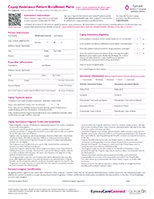
Copay Assistance Patient Enrollment Form
Click to download the Epioxa Copay Assistance Program Enrollment Form.
Download the form
Copay Assistance Brochure
An overview of the copay assistance program available to eligible patients with commercial insurance.
Download the brochureFrequently asked questions
-
What is keratoconus?
Keratoconus is a progressive disease that causes the cornea to thin and become cone-shaped, leading to visual distortion and, in advanced cases, severe visual impairment.
-
How do I say Epioxa?
eh-pee-OX-ah
-
What is Epioxa?
Epioxa is the only FDA approved, epithelium-on, oxygen-enriched, corneal cross-linking treatment for keratoconus.
-
How is Epioxa different from other treatments for keratoconus?
Epioxa is the first and only epithelium-on, corneal cross-linking treatment that is approved by the FDA to treat keratoconus.
-
Who is eligible for Epioxa?
Epioxa is approved to treat keratoconus in adults and pediatric patients aged 13 years and older.
-
Is Epioxa safe and effective to treat keratoconus?
Yes, the safety and efficacy of Epioxa were studied in 2 prospective, multicentered, randomized 2:1 sham treatment/placebo-controlled clinical trials, and was approved by the FDA for the treatment of keratoconus in adults and pediatric patients aged 13 years and older. For complete information, review the full Prescribing Information and discuss with your doctor.
-
What support programs are available for those patients who are interested in treatment with Epioxa?
Glaukos is committed to ensuring all eligible patients have access to treatment with Epioxa. Patient assistance programs will be available for eligible patients.
Only Epioxa treatment is FDA approved to slow or halt KC with a non-invasive procedure
Find a doctor
IMPORTANT SAFETY INFORMATION
The most common side effects were red eye, haze, sensitivity to light, disruption of surface cells of the cornea, eye pain, eye irritation, watery eyes, swelling of eyelid, fine white lines in the cornea, reduced sharpness of vision, dry eye, and eye inflammation.
You should not have the EPIOXA® corneal collagen cross-linking procedure if you have a known hypersensitivity to any ingredients in the product, have had cataract surgery and either did not receive an artificial lens in your eye or received a non-UV blocking artificial lens, have a history of herpetic keratitis, or are pregnant.
If you have any additional questions, please contact your doctor. Please see full Prescribing Information for EPIOXA HD and EPIOXA.
You are encouraged to report all side effects to the FDA. Visit www.fda.gov/medwatch, or call 1-800-FDA-1088. You may also call Glaukos at 1-888-404-1644.
APPROVED USES
The EPIOXA corneal collagen cross-linking procedure is performed by your eye doctor for the treatment of keratoconus. It does not require the removal of the corneal epithelium (outermost layer of the front of the eye). It consists of EPIOXA® HD (riboflavin 5′-phosphate ophthalmic solution) 0.239% and EPIOXA® (riboflavin 5′-phosphate ophthalmic solution) 0.177%, which are prescription eye drops used in combination with the O2n® System and Boost Goggles®.
The EPIOXA corneal collagen cross-linking procedure is for the treatment of keratoconus in adults and pediatric patients 13 years of age and older.